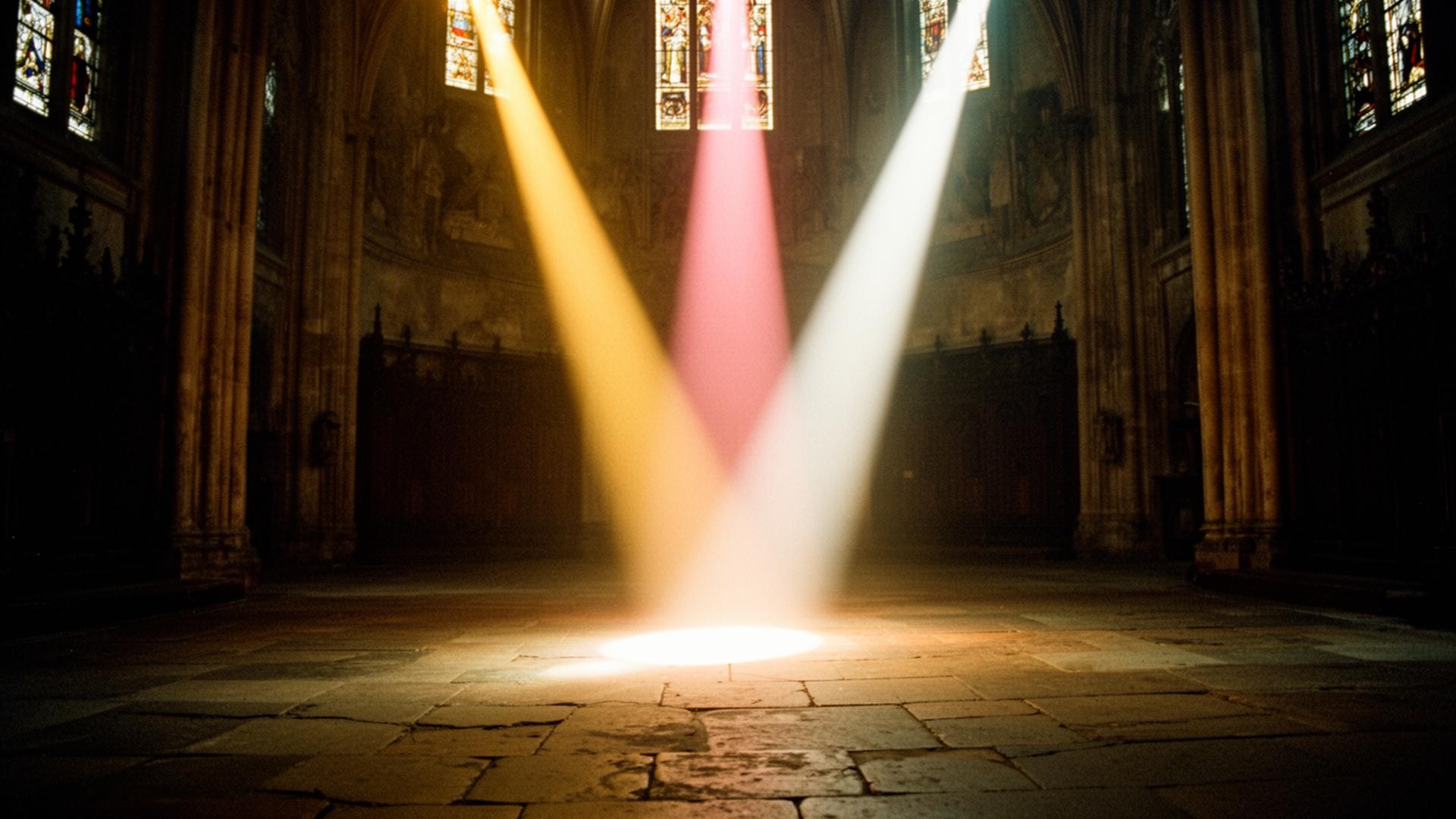
Three words have followed the human race wherever it has gone: true, beautiful, good. They appear in every language, in every century, in mouths that otherwise agree about nothing. A peasant praises a loaf of bread and a philosopher praises a proof, and they are reaching, without conferring, for the same vocabulary. We seem unable to describe what matters most to us without these three.
The old tradition had a name for this. It called them the transcendentals — the qualities of being itself, the way reality presents itself to a creature capable of receiving it. Not three separate values to be balanced like budget lines, but three faces of a single light. Whatever is, insofar as it is, is true. Whatever is, insofar as it is, is good. Whatever is, insofar as it is, is beautiful. To meet any one of them honestly is to be drawn, eventually, toward the others.
This is a strange claim. It is also, I think, the one we cannot live without and have not yet replaced.
The Three That Belong Together
Plato, in the Republic, placed the Good above all other forms — the sun under which everything else becomes visible and intelligible. Truth, for him, was not raw information but the soul's adequacy to what is. Beauty was the form by which the Good first attracted us, the lure that drew the mind upward before it knew what it was being drawn toward. The three were not equals competing; they were companions, and the deepest among them was love.
In the world of knowledge the Form of the Good appears last of all, and is seen only with an effort; and, when seen, is also inferred to be the universal author of all things beautiful and right.— Plato, Republic VII (c. 380 BCE)
The Christian tradition received this inheritance and deepened it. If God exists and is the source of all that is, then truth, beauty, and goodness are not three independent ideals we hope happen to line up. They line up because they have a single source. They are God's character refracted through what he has made. To pursue any one of them honestly is to be on the trail of him, whether the pursuer knows it or not.
Late have I loved you, Beauty so ancient and so new, late have I loved you!— Augustine of Hippo, Confessions X.27 (c. 400)
Augustine writes this not as a theologian but as a man looking back on a youth spent loving the wrong things. He had chased beauty, but only its shadows — the body without the person, the pleasure without the source. When he finally turned, he discovered that the beauty he had been chasing was not behind him in the things he had grasped but ahead of him, the very Voice that had been speaking through them all along. The transcendentals are not goals we achieve. They are a Person we are met by.
Why Pulling Them Apart Goes Wrong
The modern world has tried, with great seriousness, to keep these three and to keep them separate. Truth was given to the sciences, beauty to the arts, goodness to ethics. Each was sent to its own university building and told not to speak to the others. The result has not been more clarity but less of each.
Truth without beauty becomes brutal. A fact stripped of any sense that it matters is no longer fully a fact; it is data, and data is what we call truth that has had the music taken out of it. A culture that believes only in measurable truth eventually finds itself unable to say why anything is worth measuring.
Beauty without truth becomes decoration, then propaganda. Detached from any claim that the world really is the way it is being shown, beauty becomes a tool — a perfume sprayed over whatever the powerful want sold. The twentieth century, which produced the most accomplished aesthetes and the most sophisticated advertisers in history, also produced its most thorough cruelties. The two were not unrelated.
Goodness without truth and beauty collapses into rule-keeping or sentiment — moralism on one side, niceness on the other. Neither has the weight to hold a person up in a hard hour. A goodness that does not believe its commands correspond to anything real, and that does not move the heart as well as the will, is a goodness already preparing to fold.
Beauty will save the world.— attributed to Prince Myshkin in Fyodor Dostoevsky, The Idiot (1869)
Dostoevsky's line is famous and is often quoted as if it were sentimental. Read in context, it is anything but. Myshkin is half a holy fool and half a Christ-figure, and the "beauty" he means is not the beauty of paintings but the beauty of a holiness so complete that it is at once entirely true and entirely good — a wholeness so radiant that, encountered, it heals. The line is a prophecy about the unity of the three, not a slogan about prettiness.
What Beauty Knows That Argument Does Not
There is a reason the transcendentals so often arrive in art before they arrive in argument. Beauty is the form truth and goodness take when they need to reach the part of us that arguments cannot. A child can be lectured about honesty for a decade and remain unmoved; one well-told story, one genuinely beautiful song, can leave her changed by Tuesday. This is not a defect in reason. It is a fact about persons. We are not only minds. We are creatures with bodies, memories, longings, and a strange capacity to be addressed by what is more than ourselves.
Keats said it in the most quoted line in English poetry, and meant it more carefully than the line is usually given credit for.
Beauty is truth, truth beauty, — that is all Ye know on earth, and all ye need to know.— John Keats, "Ode on a Grecian Urn" (1819)
Keats was not saying that pretty things are automatically true. He was saying that, in the encounter with the genuinely beautiful, we are given a glimpse of what is — a glimpse our other faculties can chase for a lifetime and not quite catch. The urn does not argue. It shows. And what it shows is that the world is not, after all, only matter in motion.
C.S. Lewis, who knew this longing all his life and finally followed it home, named what beauty is actually doing to us when it does its full work.
We do not want merely to see beauty, though, God knows, even that is bounty enough. We want something else which can hardly be put into words — to be united with the beauty we see, to pass into it, to receive it into ourselves, to bathe in it, to become part of it.— C.S. Lewis, The Weight of Glory (1941)
This is the secret of why beauty hurts. It is not merely showing us a lovely thing. It is reminding us that we were made for union with the Source of all lovely things, and that we are not, yet, where we belong. Beauty is a homesickness for a country we have not visited and somehow remember.
Living Inside the Three
To take the transcendentals seriously is to refuse, every day, the small life that any one of them alone would shrink into. It is to ask of any work, any relationship, any decision: is it true — does it correspond to what really is? Is it good — does it serve what ought to be? Is it beautiful — does it ring, does it carry the weight of glory, does it belong in the kind of world we would want to live in forever?
These three questions, asked together, will not let us pretend. They will not let the entrepreneur build something profitable but ugly, or the artist make something exquisite but false, or the moralist enforce something correct but cruel. They keep watch on each other.
For the Christian, the three find their final unity in a Person. Jesus is, as he said himself, the way, the truth, and the life — the place where what is real, what is good, and what is beautiful are not three things finally agreeing but one thing that was always one. To know him is not to leave reason behind, but to follow it to its source. To love him is not to leave beauty behind, but to find the face beauty has always been pointing toward. To obey him is not to leave goodness behind, but to be drawn into the goodness that is older than any command.
Whether or not you can yet say the name with me, the three keep calling. They will call from the sound of a violin and from the shape of a proof and from a stranger's unexpected kindness. They will call until you follow them, and they will all, in the end, lead you to the same door.
A Closing Word
The sojourner travels with three companions: what is true, what is good, what is beautiful. She does not always know how to honor all three at once. But she has learned not to choose between them, because she has learned that they were never separate. They are the world telling her, in the only language it has, what it actually is — and Who it is from.
To read the world by the light of the transcendentals is to read it as it was meant to be read: as a gift, signed.