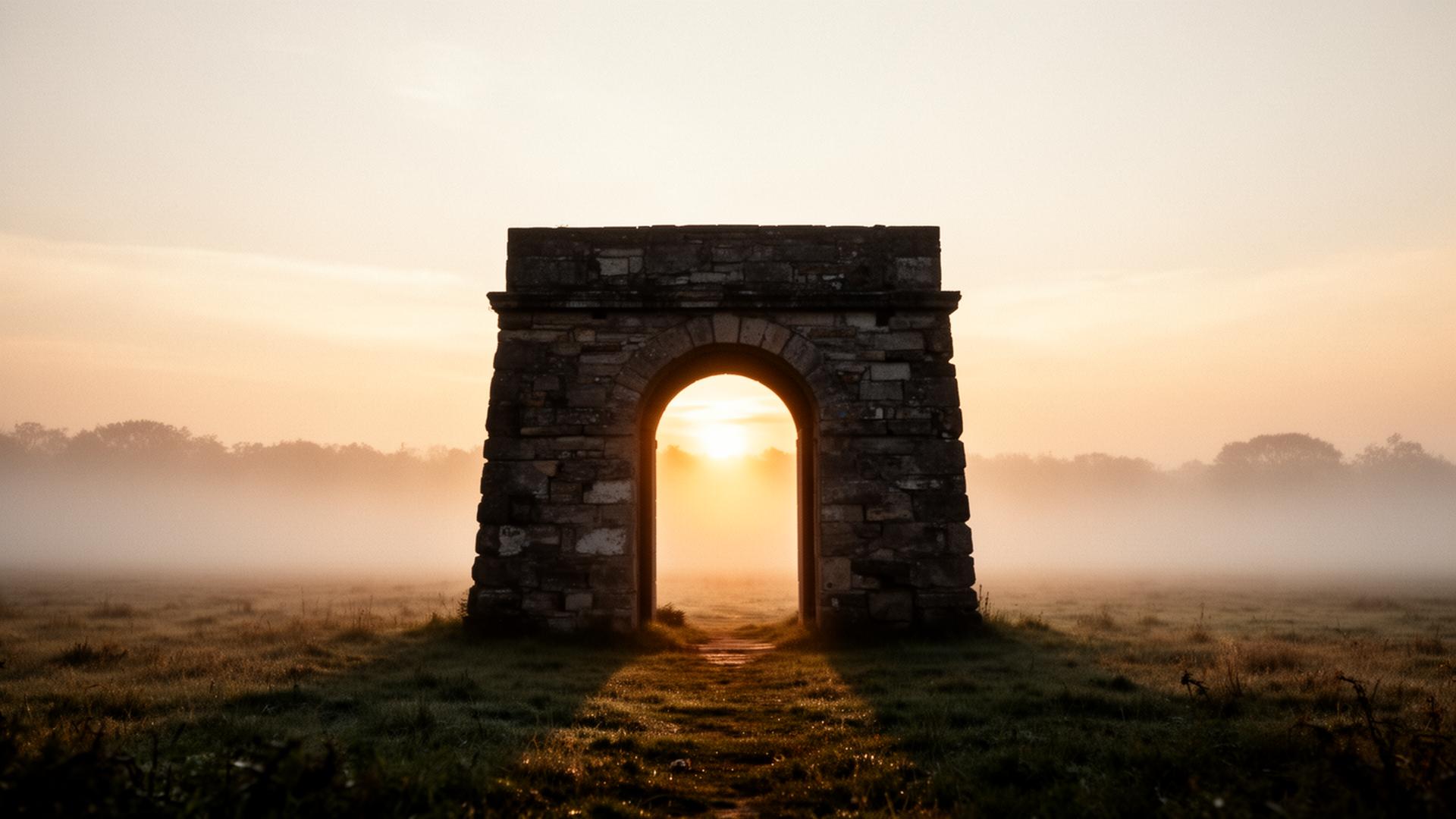
No one begins from nowhere.
This is the quiet scandal at the root of how we know anything at all. Before a single argument can be made, before evidence can be weighed, before a fact can even be recognized as a fact, the mind has already done something it cannot fully justify: it has trusted a framework. It has assumed the world is intelligible. It has assumed its own reasoning is not lying to it. It has assumed that words can carry meaning across the air between two people. None of these are conclusions. They are starting points. And starting points, by definition, are believed before they are proven.
We tend to call this kind of believing by other names when we agree with it — common sense, reason, science, the way things obviously are. We call it faith only when we notice it in someone else. But the noticing should go further. The act is the same act, wherever it happens. To begin is to presuppose. To presuppose is to believe.
The Frame Before the Picture
A photograph is not the world. It is the world cropped, lit, focused, and held still inside a rectangle that the photographer chose. The rectangle is invisible in the image, but every pixel inside it was selected by its edges. So it is with thought. Every claim we make about reality is made inside a frame we did not first prove — a frame about what counts as real, what counts as evidence, what counts as a good reason, what kind of beings we are, what kind of universe this is.
The Christian philosopher and chemist Michael Polanyi spent his career arguing that this is not an embarrassment but the very condition of knowing. Every discovery in science, he showed, rests on commitments — to the orderliness of nature, to the reliability of our minds, to the worth of the inquiry itself — that cannot themselves be proven by the methods they make possible.
We must believe in order to know.— Michael Polanyi, Personal Knowledge (1958)
Polanyi was not asking us to abandon rigor. He was asking us to be honest about where rigor stands. It stands on trust. The chemist trusts that the molecule will behave tomorrow as it did today. The historian trusts that documents bear some relation to what actually happened. The reader trusts that the author meant something. Pull any one of these trusts out from underneath, and the structure does not become more honest. It collapses.
Reason Itself Is an Act of Faith
A century ago, G.K. Chesterton put the same point more bluntly. Modern people, he noticed, liked to picture reason and faith as enemies — reason the cool, clear daylight, faith the cloudy private mood. But reason, examined closely, turned out to require its own kind of trust before it could open its eyes.
It is an act of faith to assert that our thoughts have any relation to reality at all.— G.K. Chesterton, Orthodoxy (1908)
This is not skepticism dressed up. It is the simple observation that the trustworthiness of the mind is not something the mind can prove without using itself. To argue that reason is reliable, you must already be reasoning. To argue that argument matters, you must already think argument matters. Somewhere, prior to all of it, a commitment was made.
The question is never whether we will trust something prior. The question is what we will trust, and whether the thing we are trusting can actually bear the weight we place on it.

Everybody Worships
David Foster Wallace, addressing a graduating class in 2005, said the thing in a register the secular world could finally hear. He was not preaching. He was describing.
In the day-to-day trenches of adult life, there is actually no such thing as atheism. There is no such thing as not worshipping. Everybody worships. The only choice we get is what to worship.— David Foster Wallace, This Is Water (Kenyon College commencement, 2005)
Worship, in Wallace's sense, is not incense and candles. It is the thing your life is finally organized around — the standard you measure yourself by, the loss that would feel like the end of you, the good that justifies your sacrifices. By that measure, no one has ever lived without a god. The materialist who believes only matter is real has made a metaphysical commitment as load-bearing as any creed. The seeker of comfort has made comfort a deity. The careerist has built an altar in a glass tower. None of these are non-faiths. They are faiths whose followers have not yet noticed they are faiths.
This is, in part, what the Christian tradition has always meant when it called unbelief a kind of belief in something else. The first commandment does not assume some people have no gods. It assumes everyone does, and asks which.
To Believe in Order to Understand
Long before modern epistemology, Augustine put the order of operations plainly. He had tried, in his younger years, to wait until reason had answered every question before he would commit to anything. He found, after a long detour through several philosophies and one famous garden, that the order itself was wrong. You do not first see clearly and then trust. You first trust enough to look honestly, and then you begin to see.
Crede, ut intelligas. — Believe, so that you may understand.— Augustine of Hippo, Tractates on the Gospel of John 29.6 (c. 416)
This is not anti-intellectual. Augustine spent the rest of his life writing some of the most rigorous theology and philosophy the West has produced. His point was structural. Understanding does not float free. It grows out of a soil of prior commitments — to the goodness of inquiry, to the existence of truth worth finding, to the possibility that the universe is the kind of place where asking honest questions might be rewarded with honest answers. None of those are conclusions. They are the conditions under which conclusions become possible.
The same is true outside religion, and it should be said clearly. A scientist believes the universe is law-like before she finds the law. A historian believes the past was real before she finds the records. A husband believes his wife is faithful before he sees the evidence of any given Tuesday. Trust precedes verification. It is not a regrettable weakness in the machinery of knowing; it is the way knowing has always worked.
Choosing What to Stand On
If everyone presupposes, then the honest question is not whether to have a framework but which framework is worth standing on. Here, finally, the conversation can become serious. We can ask of any worldview: does it account for what we actually find ourselves doing every day — loving, mourning, reasoning, calling some things evil and some things beautiful? Does it leave room for the things it claims to value? Does it explain itself, or does it have to borrow, quietly, from another worldview to keep its own arguments running?
For my part, I have come to think that the Christian framework — that there is a God who is personal, rational, and good, who made a world that reflects his character, and who made us in his image to know him, to know it, and to know each other — is the soil in which the things I cannot stop believing in actually grow. Reason works because there is a Mind behind the world. Beauty pierces because beauty is real. Love is not a chemical bribe because love is rooted in the very life of God. The frame is not a cage; it is a window cut so the light can come in.
Others will land elsewhere, and the conversation between us is a real one — the kind worth having, the kind we can only have once we have stopped pretending one of us is reasoning from nowhere and the other one is merely believing. Both of us are believing. Both of us are reasoning. The only question, and it is the oldest one, is whom and what we trust, and whether that trust is finally borne out by the world we wake up in each morning.
A Closing Word
To call this faith is not to insult it. It is to name it accurately. Every human being is a creature who must begin somewhere, and the somewhere is always more than the evidence in front of them. We are not, and never have been, brains hovering above the data. We are people standing inside a story we did not write, asking what kind of story it is and how to live well within it.
To know that we presuppose is the beginning of intellectual honesty. To choose carefully what we presuppose is the beginning of wisdom. The sojourner does not pretend to have no map. She admits she has one, takes it out into the open air, and asks whether the country itself confirms the lines she has drawn.
That, I think, is what thinking actually is. Not the absence of faith, but its careful, lifelong examination.